
The core banking platform market has never been more competitive — or more consequential. As financial institutions face mounting pressure to modernize legacy infrastructure, choosing the right core banking platform is no longer just an IT decision; it's a strategic imperative that will define your institution's agility, cost structure, and competitive position for the next decade.
In 2026, the market has matured significantly. The days of "lift and shift" migrations are over. Today's leading platforms offer cloud-native architectures, API-first designs, and modular deployments that allow institutions to modernize incrementally. But with over 60 vendors claiming "next-generation" status, how do you separate genuine innovation from marketing noise?
This guide provides a structured framework for evaluating core banking platforms, compares the leading vendors across key dimensions, and offers practical advice for making the right choice.
The Core Banking Market in 2026
The global core banking software market is projected to reach $28.78 billion by 2030, growing at a CAGR of 9.3% from 2024. But the real story isn't the market size — it's the fundamental shift in what "core banking" means.
Traditional core banking was a monolithic system that handled everything from account management to regulatory reporting in a single, tightly-coupled application. Modern core banking is a composable platform — a set of independent, API-connected modules that can be assembled, replaced, and scaled independently.
This shift has profound implications for selection criteria. You're no longer choosing a system; you're choosing an ecosystem.
Key Market Trends Shaping Selection
1. Composable Architecture Is Table Stakes Every major vendor now claims composable or modular architecture. The differentiation lies in how genuinely modular the platform is — can you actually deploy individual modules independently, or is "modular" just a marketing label for a monolith with APIs bolted on?
2. Cloud-Native vs. Cloud-Hosted There's a critical difference. Cloud-native platforms are built from the ground up for cloud deployment, using containers, microservices, and event-driven architectures. Cloud-hosted platforms are traditional software running on cloud infrastructure. The operational, scaling, and cost implications are vastly different.
3. Embedded Finance Is Driving New Requirements Banking-as-a-Service (BaaS) and embedded finance are creating demand for platforms that can power banking services embedded in non-financial products. This requires multi-tenancy, sophisticated API management, and the ability to configure products for thousands of different use cases simultaneously.
4. Regulatory Technology Integration With PSD3, DORA, MiCA, and the EU AI Act all coming into force, core banking platforms must offer built-in regulatory compliance capabilities — or seamless integration with regtech providers. Compliance is no longer an afterthought.
Evaluation Framework: The 7 Pillars
When evaluating core banking platforms, we recommend assessing vendors across seven critical dimensions:
1. Architecture & Technology
- Deployment model: True cloud-native (containers/Kubernetes) vs. cloud-hosted
- API design: RESTful, event-driven, GraphQL support
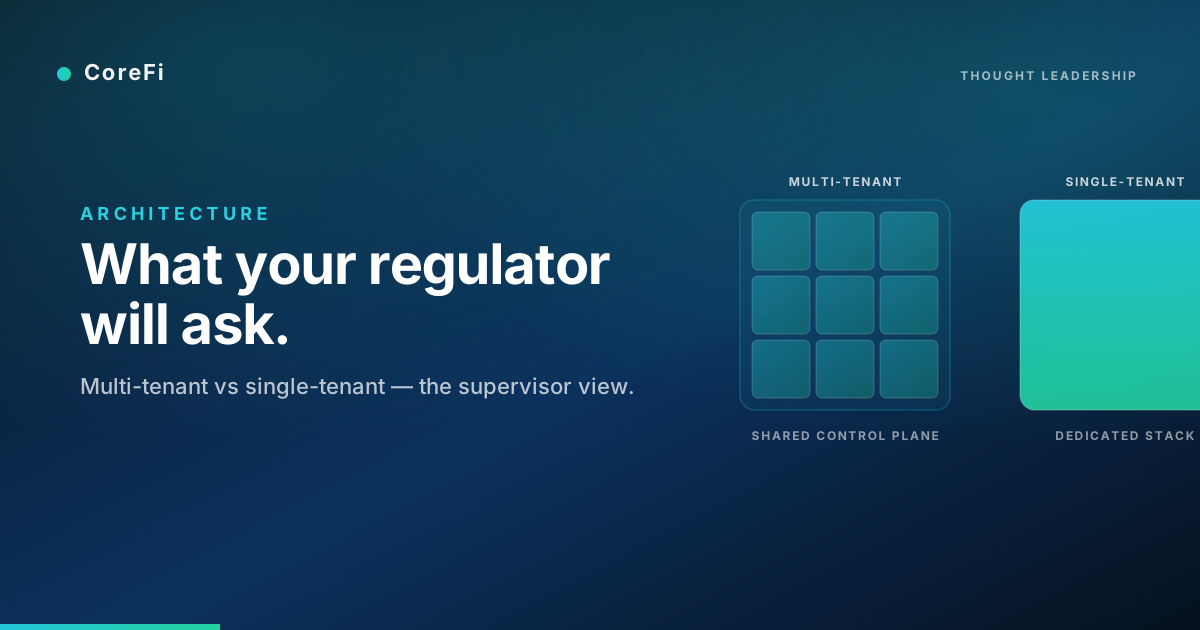
- Multi-tenancy: Can it serve multiple clients/brands from a single deployment?
- Database architecture: Event sourcing, CQRS, or traditional CRUD
- Scalability: Horizontal scaling, auto-scaling capabilities
- Technology stack: Modern languages and frameworks vs. legacy
2. Product Configuration
- Account types: Current, savings, loan, investment, multi-currency
- Product builder: No-code/low-code product configuration
- Pricing flexibility: Complex fee structures, tiered pricing, promotional rates
- Multi-currency: Native multi-currency support with real-time FX
- Interest calculation: Compound, simple, tiered, variable rate
3. Integration & Ecosystem
- API coverage: What percentage of functionality is exposed via API?
- Pre-built integrations: Payment schemes (SEPA, SWIFT, Faster Payments), KYC providers, card processors
- Marketplace: Partner ecosystem breadth
- Webhook/event support: Real-time event streaming
- Developer experience: Documentation quality, sandbox, SDKs
4. Regulatory Compliance
- Built-in compliance: AML screening, transaction monitoring, regulatory reporting
- Multi-jurisdiction: Support for multiple regulatory frameworks
- DORA readiness: Operational resilience, ICT risk management
- Audit trail: Immutable audit logging
- Data residency: Options for data location and sovereignty
5. Implementation & Migration
- Time to market: Typical deployment timeline
- Migration tools: Legacy data migration capabilities
- Parallel running: Can you run old and new systems simultaneously?
- Professional services: Implementation support quality
- Partner ecosystem: System integrators certified on the platform
6. Total Cost of Ownership
- Licensing model: SaaS subscription, transaction-based, hybrid
- Infrastructure costs: Included in subscription or separate
- Implementation costs: Professional services, customization
- Ongoing costs: Maintenance, upgrades, compliance updates
- Hidden costs: Integration development, training, change management
7. Vendor Viability
- Financial health: Revenue, funding, profitability trajectory
- Client base: Number of live clients, reference clients in your segment
- R&D investment: Product roadmap, innovation pace
- Market position: Analyst recognition (Gartner, IDC, Forrester)
- Geographic presence: Support in your operating markets
Vendor Comparison
Mambu
Best for: Large-scale digital banks and BaaS providers seeking a proven platform with global reach.
Mambu has established itself as the dominant cloud-native core banking platform, with over 230 customers across 65 countries. Its composable banking approach and strong partner ecosystem make it a safe choice for institutions that prioritize proven track record over cutting-edge innovation.
Strengths: Largest customer base among next-gen vendors, strong partner ecosystem, proven scalability (processes billions of transactions), good analyst recognition.
Considerations: Premium pricing positions it at the top of the market, some customers report slower innovation cycles, heavy reliance on partner ecosystem for functionality that competitors offer natively.
Tuum
Best for: European institutions seeking deep multi-currency and embedded finance capabilities.
Estonia-based Tuum has built a strong reputation in the European market, particularly for BaaS use cases. Its architecture is genuinely cloud-agnostic and its multi-currency capabilities are among the best in the market. Notable clients include LHV (powering BaaS for 200+ fintechs including Wise and Coinbase).
Strengths: Excellent multi-currency support, cloud-agnostic (not locked to a single provider), strong BaaS credentials, real-time processing.
Considerations: Smaller team and customer base than Mambu, limited presence outside Europe, fewer pre-built integrations.
Skaleet
Best for: European financial institutions prioritizing strategic autonomy and fast time-to-market.
French-based Skaleet has been gaining ground with its "ecosystem orchestrator" positioning. They claim sub-4-month digital bank launches and emphasize vendor independence — their platform integrates with any partner without lock-in.
Strengths: Fast implementation timelines, strong European regulatory knowledge, good content marketing and thought leadership, emphasis on strategic autonomy.
Considerations: Smaller than Mambu and Tuum, still building out partner ecosystem, limited track record in large-scale deployments.
Temenos
Best for: Large banks requiring comprehensive functionality and a proven migration path from legacy Temenos systems.
As the incumbent market leader with 3,000+ banking clients, Temenos offers the most comprehensive functionality. Its Temenos Banking Cloud represents a genuine modernization of its platform, though some argue it's still an evolution of legacy architecture rather than a ground-up rebuild.
Strengths: Most comprehensive functionality, largest installed base, strong regulatory compliance, proven at massive scale.
Considerations: Higher complexity and cost, longer implementation timelines, architecture questions (evolution vs. revolution), licensing model can be opaque.
CoreFi
Best for: Fintechs, neobanks, and mid-size institutions seeking modular infrastructure with native lending, tokenization, and emerging technology capabilities.
CoreFi takes a different approach to core banking — rather than trying to be everything, it offers a truly modular platform where institutions can adopt individual capabilities (core banking engine, lending-as-a-service, asset tokenization, customer onboarding) independently or together. Its European base and regulatory expertise make it particularly well-suited for MiCA, DORA, and PSD3 compliance.
Strengths: Genuinely modular (adopt one module or all), native asset tokenization and crypto capabilities (unique in the market), lending engine with proven track record, EU regulatory expertise, competitive pricing for the functionality offered.
Considerations: Smaller company than Mambu or Temenos, building out enterprise reference clients, newer entrant in the "platform" positioning.
Selection Decision Framework
Step 1: Define Your Use Case
Are you building a digital bank from scratch, modernizing a legacy system, launching a BaaS offering, or adding specific capabilities (like lending or tokenization)?
Step 2: Prioritize Your Pillars
Rank the 7 evaluation pillars by importance for your specific situation. A startup neobank will weight time-to-market and cost differently than a mid-size bank modernizing legacy infrastructure.
Step 3: Create a Shortlist
Based on your use case and priorities, narrow to 3-4 vendors for deeper evaluation.
Step 4: Proof of Concept
Run a structured PoC with your top 2-3 vendors. Define success criteria upfront and evaluate against them rigorously.
Step 5: Reference Checks
Speak to existing clients — specifically those in your segment and geography. Ask about implementation experience, ongoing support, and whether the platform delivers on its promises.
The Bottom Line
There is no single "best" core banking platform. The right choice depends on your specific situation, priorities, and trajectory. What matters most is making a structured, evidence-based decision rather than being swayed by marketing narratives or analyst quadrant positions.
The vendors that will win in 2026 and beyond are those that genuinely deliver on composability, invest in emerging capabilities (AI, blockchain, embedded finance), and partner with their clients rather than locking them in.
Looking to evaluate core banking platforms for your institution? to see how CoreFi's modular approach compares.