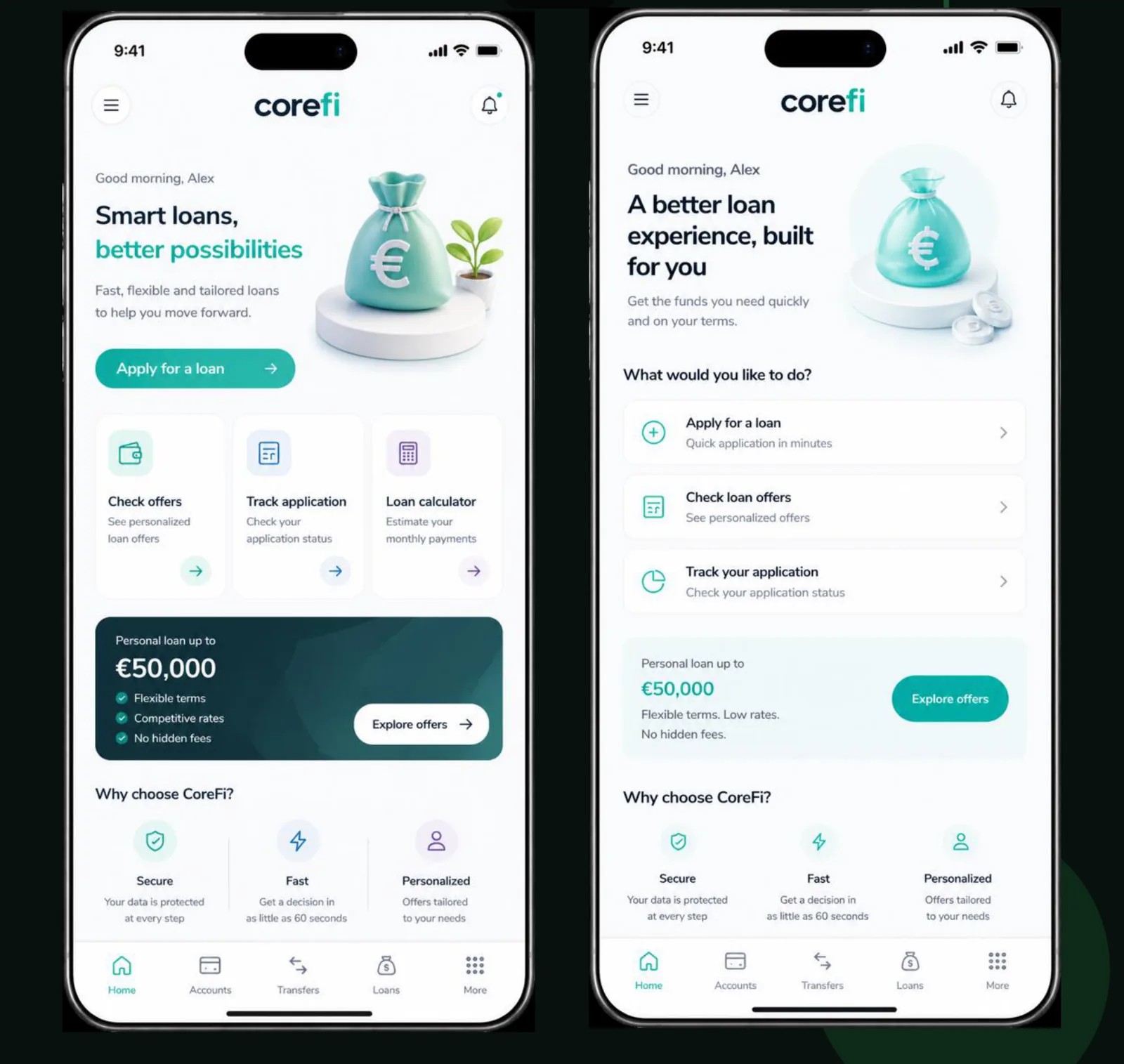
Platform / Lending-as-a-Service

The lending lifecycle, run as one AI-orchestrated journey.

CoreFi treats lending as a single governed lifecycle — eligibility, underwriting, offer, disbursement, servicing, collections and audit — not a stack of disconnected products. AI agents prepare each case, policy gates check it and human underwriters, operators and risk owners approve every threshold. One platform, one ledger, one case-level audit record from first application to final repayment.

See it in motion

The seven-stage lifecycle, in 1 minute 41.

Watch the Lending Agent prepare a case, the policy gates check it and the underwriter approve it — across all seven stages, on one ledger and one audit record.

Lifecycle stages

Seven stages from eligibility to audit, one governed lifecycle.

Every CoreFi lending journey moves through the same seven stages. Each stage writes into the same ledger and case record, so the same evidence supports the underwriting decision, the disbursement, the servicing event and the audit pack.

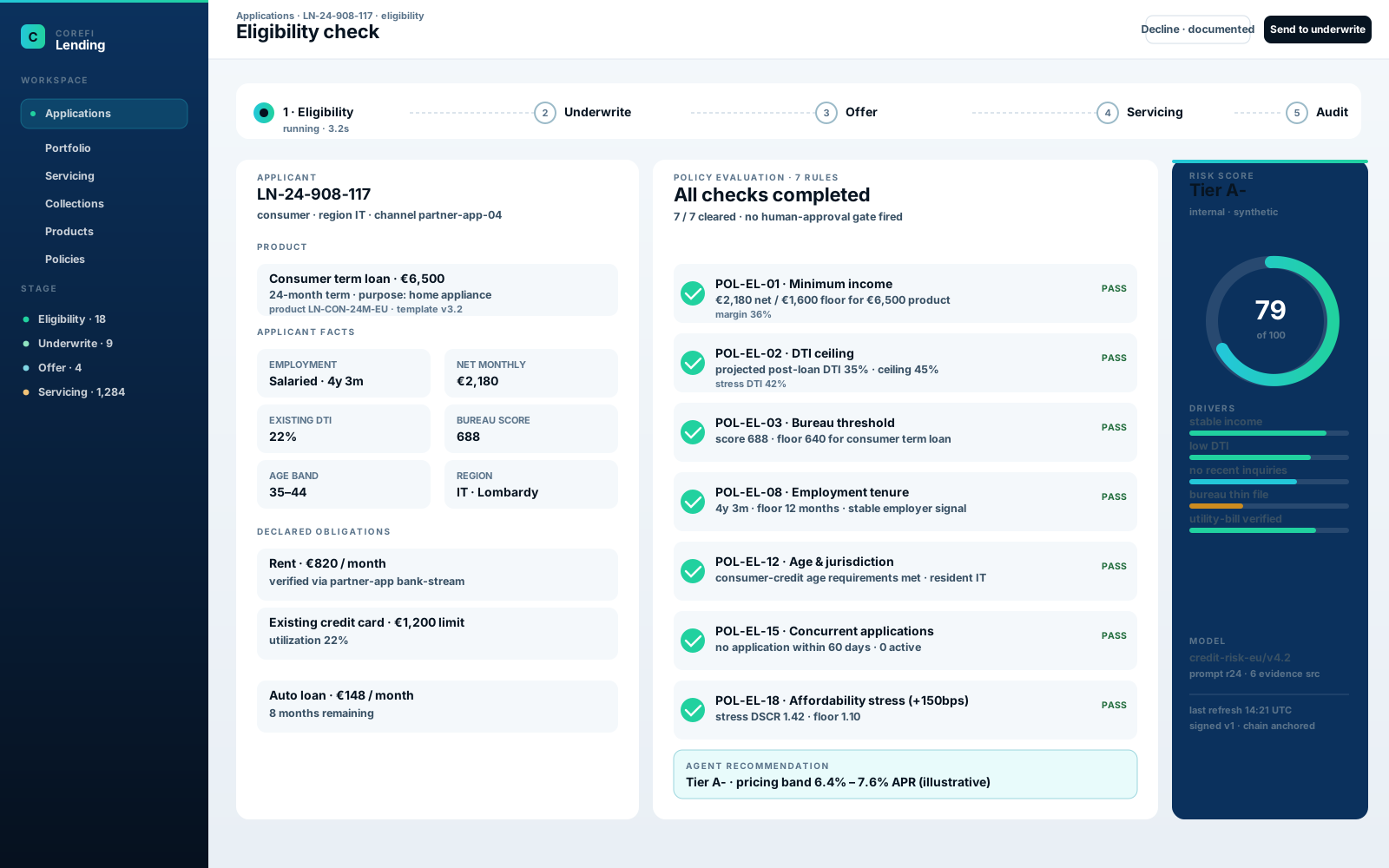
Lending eligibility check: 7 policy gates pass, applicant facts, recommended pricing band, and a synthetic risk score dial. Illustrative consumer case.
Stage 1 — Eligibility, with policy gates and the recommended pricing band. Illustrative data.
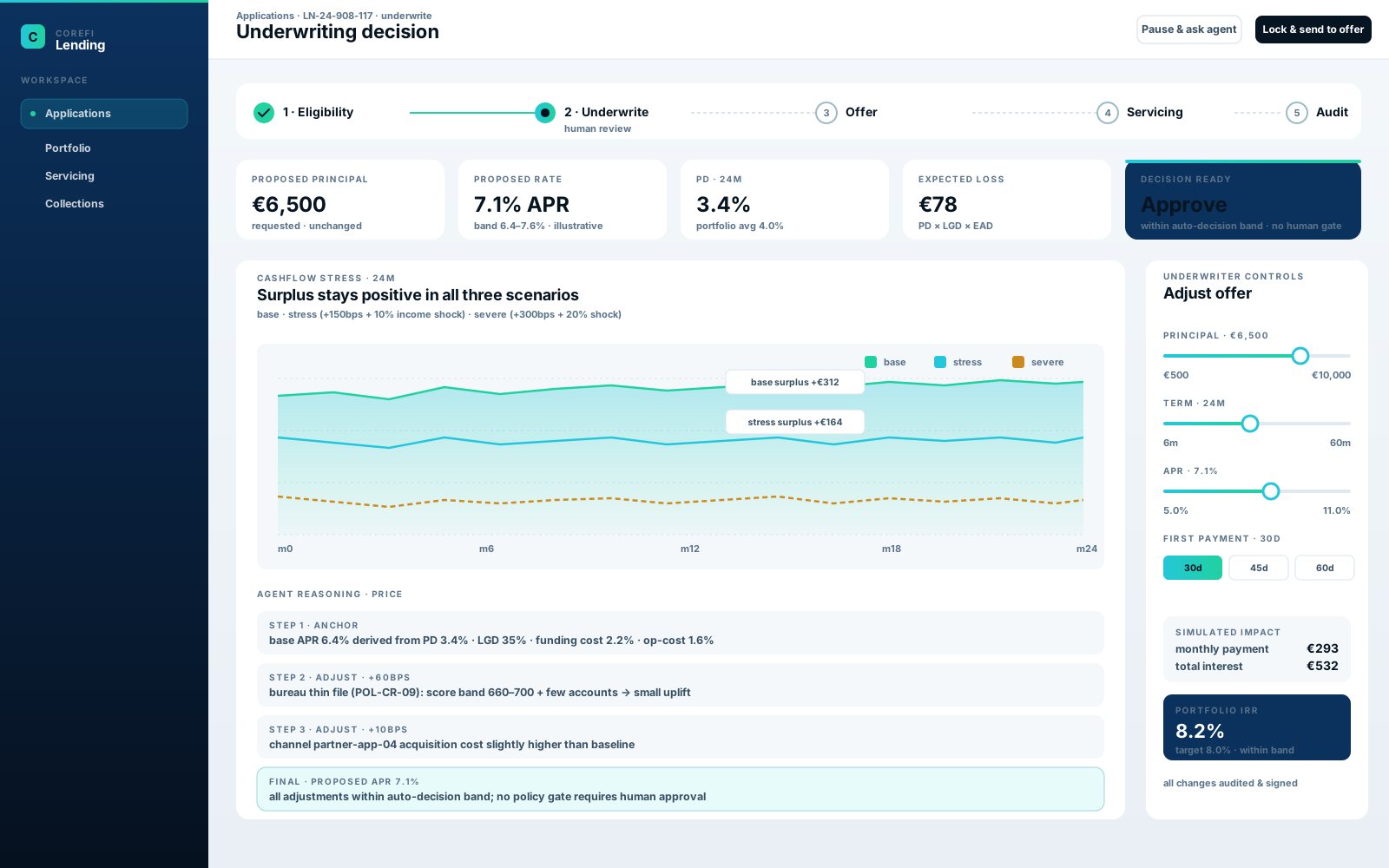
Underwriting decision: 24-month cashflow stress chart with base, stress and severe scenarios, agent-priced APR with three adjustments, and underwriter controls. Illustrative data.
Stage 2 — Underwriting, with cashflow stress and agent-proposed APR for the underwriter to decide. Illustrative data.
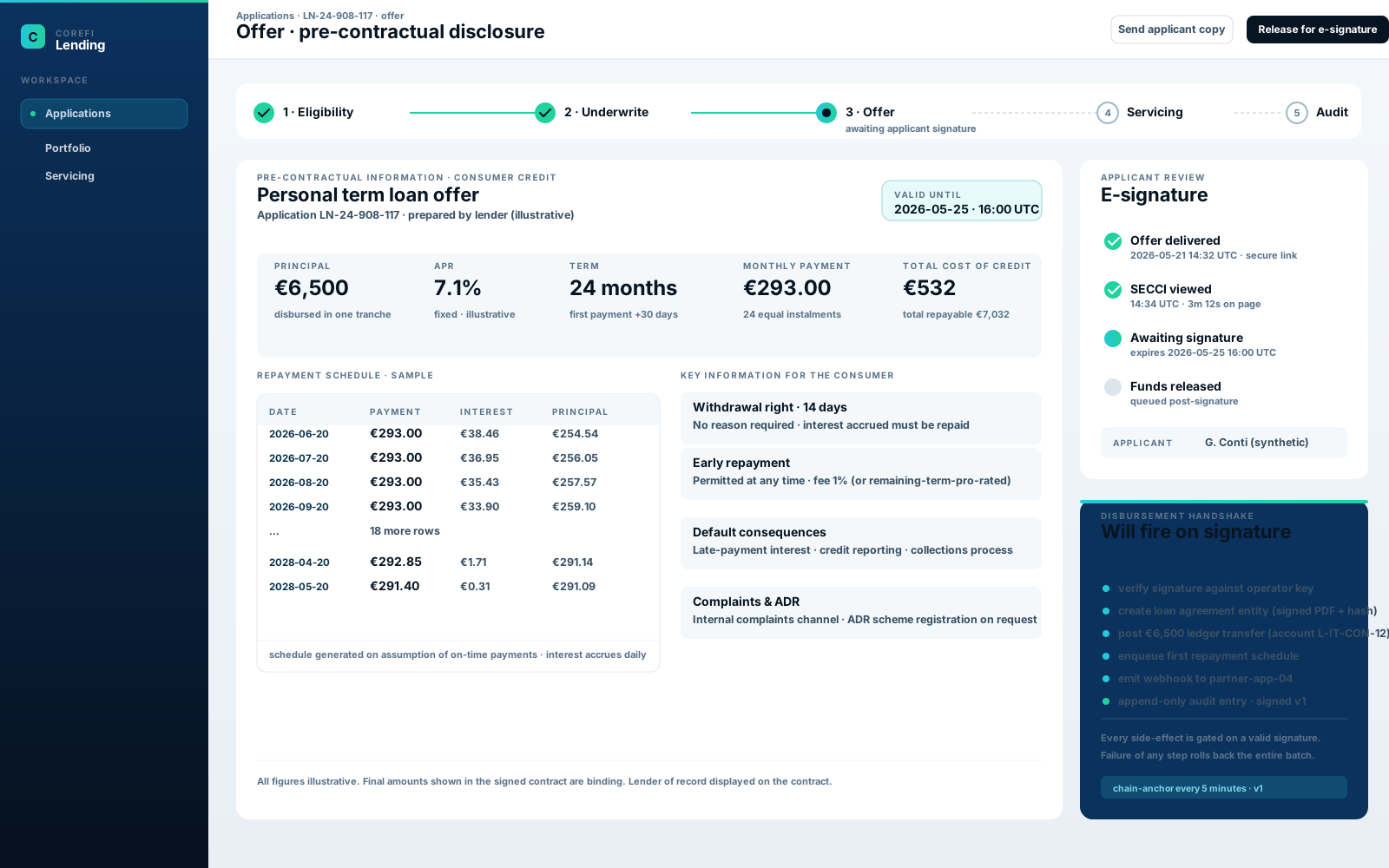
Lending pre-contractual offer: key figures, sample repayment schedule, consumer key-information block, e-signature progress and disbursement handshake. Illustrative data.
Stage 3 — Offer, with the pre-contractual key-information block and the e-signature handshake. Illustrative data.
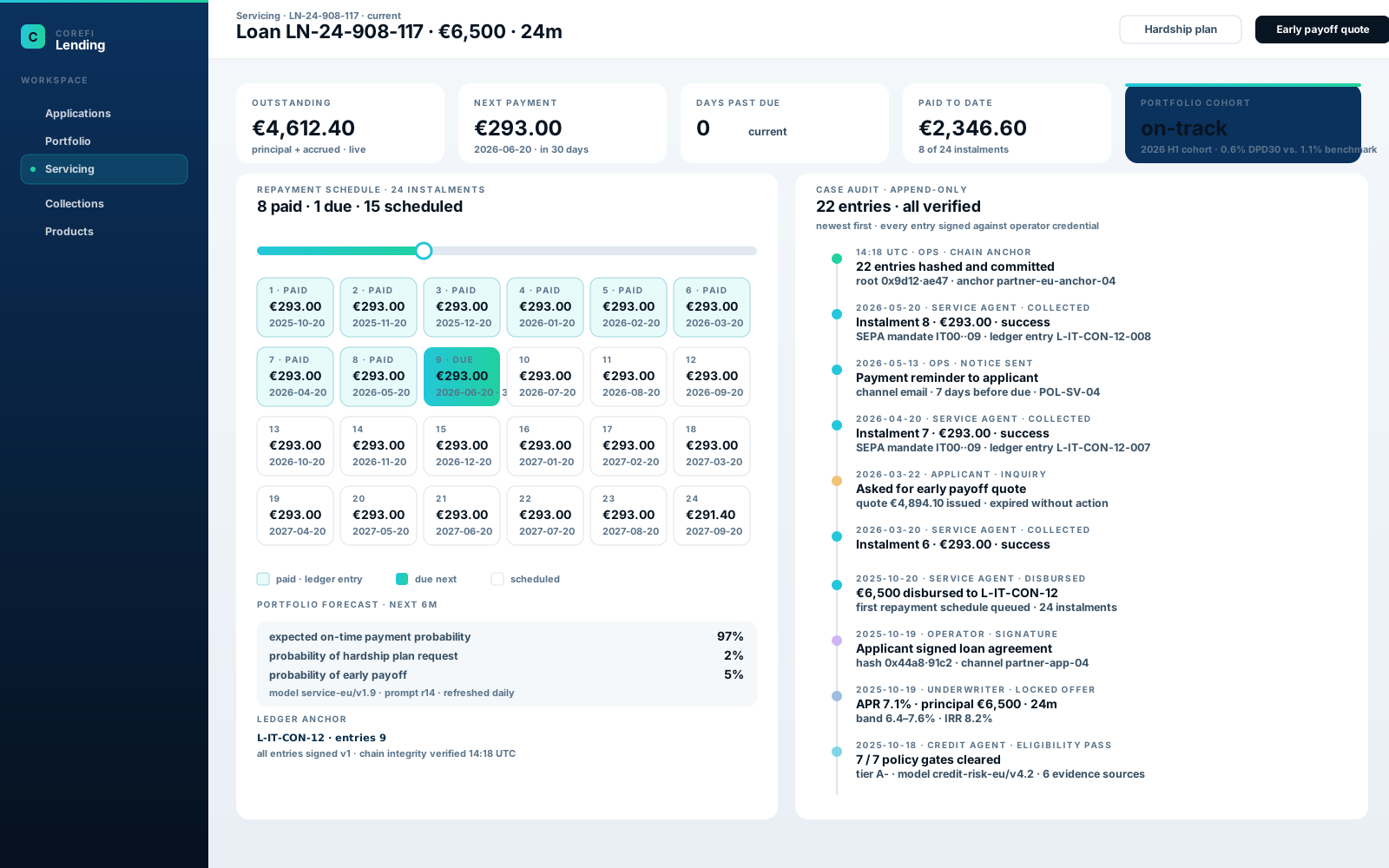
Live loan in servicing: balance, next payment, 24-instalment grid with 8 paid and 1 due, portfolio forecast and 10-entry append-only audit timeline. Illustrative data.
Stages 4–5 — Servicing and audit, with the instalment grid and an append-only timeline. Illustrative data.
01

Eligibility

The borrower applies through your branded journey, partner channel or API. CoreFi captures product, amount, purpose and customer state, runs identity and basic policy filters, and produces an eligibility decision before any underwriting effort is spent on a case that cannot proceed.

02

Underwriting

Bureau, open-banking and internal data are pulled and classified. Configurable models score affordability, risk and policy fit. The Lending Agent drafts a structured underwriting memo with the evidence, the proposed limit and pricing, and the policy rationale — ready for a human underwriter to review and decide.

03

Offer

Limit, rate, term and conditions are issued against approved policy thresholds. Offers within thresholds reach the borrower in your brand; offers above thresholds wait for an underwriter sign-off. Every change between the agent's draft and the issued offer is logged on the case.

04

Disbursement

The loan contract is generated from the approved offer, signed digitally and attached to the case record. Funds are released against the contract through configured payment rails or your treasury, the loan account opens in the ledger and the first repayment is scheduled — one continuous record, not a hand-off between systems.

05

Servicing

Real-time payment monitoring, automated reminders, partial-payment handling, statements and reconciliation against the schedule. Restructuring — term changes, payment holidays, refinancing — is proposed by the agent or initiated by the operator, approved by policy and rebooked in the same ledger.

06

Collections

Overdue accounts move through workflow-driven outreach: messaging, repayment plans, escalation paths, hand-off to specialised teams or external partners. Every contact, promise-to-pay and arrangement is written to the case, so collections never operates outside the same lifecycle record.

07

Audit & evidence

One append-only case-level record per loan: the prompts and retrieved data the agent used, the policy decisions, the human approvals, the API calls, the ledger postings and the outcome. Exportable for internal review and designed to support supervisory examinations in the Trust Center.

Lifecycle on CoreFi

Origination through collections, as one governed lifecycle.

A loan on CoreFi runs as one case from origination to closure — not seven systems stitched together. The Credit Agent operates inside the lifecycle, the human underwriter approves what policy reserves for them, and one append-only audit record is kept per borrower.

Lending lifecycle on CoreFi: seven stages with the Credit, Service and Operations Agents annotated per stage and a human-underwriter approval gate at the decision stage. 01 Origination (capture the application), 02 Data pull (bureau, open banking, KYC documents through permissioned APIs), 03 Underwrite (statement classification, affordability and risk scoring, drafted memo and proposal), 04 Decide (set limit and pricing — control gate, human underwriter sign-off above policy thresholds), 05 Disburse (contract, ledger posting, loan record live), 06 Service (statements, hardship requests, restructuring; monetary actions are policy-gated), 07 Collections (delinquency flow, recovery actions, write-off or close). The whole lifecycle runs as one case with an append-only audit keyed to borrower and model version.
AI agents along the lifecycle

Five agents, each touching a defined slice of the journey.

The CoreFi platform exposes five governed agent roles. Each one acts on a specific slice of the lending lifecycle through scoped APIs, with policy gates in front and human approval where policy requires — the model proposes, CoreFi enforces, the operator decides.

Onboarding Agent

Triages KYC and KYB at Eligibility: parses ID documents, extracts beneficial owners, runs sanctions and PEP screens, scores risk indicators and prepares a structured review packet for the queue.

Touches: Eligibility.

Lending Agent

Owns the credit case at Underwriting and Offer: pulls bureau and open-banking data, classifies bank statements, drafts the underwriting memo, proposes a limit and pricing, prepares the offer document for human sign-off and tracks every override.

Touches: Underwriting, Offer.

Operations Agent

Drives Disbursement and the operational side of Servicing: validates contract execution, schedules first repayment, watches payment queues, proposes reconciliation fixes and prepares end-of-day packs for the back office.

Touches: Disbursement, Servicing.

Service Agent

Handles borrower questions during Servicing: read-only answers on statements, balances and schedule; ticketed write actions (restructure proposal, payment-holiday request) prepared for an operator to release.

Touches: Servicing.

Compliance Agent

Investigates AML, transaction-monitoring and conduct alerts that surface during Servicing, Collections and the Audit & evidence stage: pulls customer history, ranks indicators, drafts the case narrative and prepares the report template with evidence.

Touches: Servicing, Collections, Audit & evidence.

See the agent control plane →

Approval gates

Human-in-the-loop at every threshold.

No CoreFi agent approves a loan, releases funds, restructures a contract or closes a compliance case on its own. Each stage has a declared threshold; once it is crossed, CoreFi routes the case to the right reviewer with the agent's draft, the evidence and the exact action waiting for sign-off.

01

Eligibility & Underwriting

High-risk KYC/KYB classifications, sanctions hits and edge-case documents route to a human reviewer. Every credit decision above the bank's policy thresholds requires a human underwriter sign-off before any offer is issued.

02

Offer & Disbursement

Offers above policy thresholds wait for underwriter approval. Disbursement requires a fully executed contract on the case and any treasury-side limit check the institution configures. Nothing leaves the ledger without the human-named approver on record.

03

Servicing & Collections

Restructures, fee waivers, payment holidays and refunds need an operator to approve before they post. Collections escalations, write-offs and external hand-offs route to specialised teams with the full case history attached.

04

Audit & oversight

Filing decisions, suspicious-activity reports and high-severity compliance closures stay with the compliance officer. Model and policy changes go through a versioned change-control flow so the audit record always names the version in effect at the time of the decision.

Compliance & audit posture

Built as the system of record an auditor expects.

CoreFi is a platform vendor; the licensed lender remains the regulated entity. CoreFi is designed to support the controls a lender already runs — not to replace them, claim them or speak on their behalf.

Case-level audit record

One append-only case-level record per loan: prompts, retrieved data, model and policy versions, agent draft, policy outcome, human decisions, API calls and final ledger state. Designed to support internal, external and supervisory review.

Policy-as-code thresholds

Risk thresholds, exposure limits, jurisdictional rules and approval routings live in a runtime policy layer the agent must pass through before any side effect — configurable per product, per segment and per channel.

Evidence on request

Audit packs, evidence exports and platform attestations are available on request through the customer's account team. Standards coverage and certification scope are published in the Trust Center as they are achieved.

Open the Trust Center →

Lender personas served

One lifecycle, three lender shapes.

The same governed lifecycle is configured differently for the three customer profiles CoreFi serves today. Each profile picks the stages it needs and the deployment model that fits its operating boundary.

Banks

Incumbent and challenger banks running CoreFi alongside, or instead of, a legacy core. Use lending-lifecycle journeys for unsecured retail, SME or specialised products — with the audit trail and approval flows their supervisor already expects.

For Banks →

Digital lenders

Direct-to-consumer and SME-focused lenders that need origination, decisioning, servicing and collections on one platform — with configurable scoring and a borrower journey that ships in their brand, not a vendor UI.

For Digital Lenders →

Embedded lending platforms

Fintechs and neobanks embedding lending inside their app, marketplace or partner channel. CoreFi runs the lifecycle behind their experience layer; their team owns the customer relationship and the regulated wrapper.

For Fintechs & Neobanks →

Proof and outcomes

Verified scale, not pitch-deck numbers.

Every figure below reflects production CoreFi deployments and matches the proof bar on the home page. We publish what we can prove and replace estimates with evidence as customers go live.

6Live geographies — Italy, Spain, France, Argentina, Chile, Bolivia.
20+Production deployments across banks, lenders and fintechs.
200k+End-customer accounts running on CoreFi rails.
99.9%Platform uptime measured against operational SLOs.
8–10 wksAverage go-live for a first banking journey on CoreFi.
HundredsEcosystem integrations across KYC, payments, scoring and data.

See CoreFi in production →

Run the full lending lifecycle on one governed platform.

We will walk you through the seven stages on a real loan file, show the Lending Agent's memo, the policy gates and the case-level audit record — and scope a first deployment with your team.