01
Cloud-native core
A modern real-time ledger, product engine and API layer designed for elastic cloud deployment, not a screen-scrape over a legacy mainframe and not a workflow tool stitched on top of someone else’s core.

The real-time banking core, lifecycle workflows and governed AI control plane for regulated financial institutions. CoreFi runs accounts, payments, lending and onboarding on a cloud-native core, and lets AI agents operate those workflows under permissions, policy gates, audit trails and human approvals.
A guided walk-through of the seven-step banking lifecycle, the four platform pillars, the five agent roles and the case-level audit record, in under a minute, for executives and product leaders evaluating CoreFi.
Agentic AI Cloud Core Banking is a new category of banking platform that combines three layers in one product: a cloud-native real-time core, end-to-end lifecycle workflows for onboarding, lending and servicing, and a governed AI control plane that lets agents run those workflows under enforceable banking controls.
A modern real-time ledger, product engine and API layer designed for elastic cloud deployment, not a screen-scrape over a legacy mainframe and not a workflow tool stitched on top of someone else’s core.
Onboarding, lending, servicing, operations and compliance are first-class workflows inside the platform, not afterthoughts bolted on through third-party orchestration engines.
AI agents act as operators of those workflows through scoped APIs, policy gates and human approval queues. The model proposes; CoreFi enforces; the audit log keeps one record per case.
Experience, agentic workflow, banking services, ledger and event fabric, and ecosystem integrations, stacked on one platform that runs as SaaS or a private deployment, stays API-first and keeps change governed.

Most banking cores were never designed to be operated by a non-human caller. Adding an AI agent on top of them creates three structural problems no model can solve on its own.
Legacy cores expose batch jobs and operator screens, not fine-grained APIs with role, scope and limit per caller. An agent either gets too much access or none at all.
Risk thresholds, segment rules, jurisdictional limits and approval routings sit in tribal knowledge, spreadsheets and committee minutes, not in a runtime that an agent must pass through before any side effect on the ledger.
Audit trails are transaction-level, not case-level. There is no single record that ties a prompt, the retrieved data, the model output, the policy decision and the resulting API calls to one customer case, the format supervisory review increasingly expects.
CoreFi is delivered as one product with four functional pillars. They share the same data model, the same identity and permission model, and the same governed control plane, so an agent that opens an account, decides a loan and resolves a service ticket does it inside one platform, not three.
Cloud-native real-time ledger, accounts, wallets, product engine, payments and reporting. The system of record everything else posts into.
KYC, KYB, AML, document capture and consent for retail and business customers: the funnel an Onboarding Agent prepares cases inside, with policy gates before any account opens.
Origination, decisioning, servicing, restructuring and collections as one lifecycle: the workflow a Credit Agent operates in, with risk thresholds and human underwriter approval built in.
The control plane that wires permissions, policy gates, approval routing and audit across every pillar. Agents act through it, or they do not act at all.
Whether the agent is opening an account, deciding a loan, reconciling treasury or investigating a compliance alert, every CoreFi workflow follows the same governed lifecycle. The model proposes; CoreFi enforces; the human approves what the policy says they must.
The agent receives a banking trigger: a new applicant, an inbound payment, a customer message, a portfolio breach, a scheduled reconciliation. It pulls the relevant context from the core, KYC vendor, document store and ledger through permissioned APIs.
The agent drafts a structured action plan: which APIs it will call, which limits and rules apply, which evidence supports the decision. It is a machine-readable proposal, not free text.
CoreFi runs the plan through policy gates before any side effect: role permissions, customer consent, transaction and exposure limits, AML and sanctions filters, model-output guardrails, jurisdiction rules. Failed checks stop the workflow.
If checks pass, CoreFi executes the plan through the same APIs a human operator would call: open an account, post a journal entry, release a payment, update a case. Nothing bypasses the core.
Every step is written to an append-only case-level audit record keyed to the workflow, the customer and the model version: model context, retrieved data, plan, policy decision, API calls, outcomes. One record per case, designed to support supervisory review.
When a policy gate routes a step to a human, CoreFi prepares the case in the reviewer dashboard with the evidence, the agent’s recommendation and the exact action awaiting approval. The human approves, rejects or edits; the workflow resumes from there.
Outcomes feed back into the workflow: which agent recommendations got accepted, which were overridden, which produced exceptions downstream. Risk and model owners see the signal; the model never gets uncontrolled write access to its own behaviour.
Every agent operating on CoreFi follows the same governed seven-step lifecycle. The model proposes; CoreFi enforces; the human approves what policy says they must. The diagram below visualises the prose above as a single horizontal flow.

Each role uses the same seven-step lifecycle. The difference is which APIs it can call, which policies apply and which humans approve.
Runs credit applications end-to-end: pulls bureau and open-banking data, classifies bank statements, drafts the underwriting memo, proposes a limit and pricing, prepares the offer document.
Approval gate: every credit decision above policy thresholds requires a human underwriter sign-off before the offer is issued.
Triages KYC and KYB intake: parses ID documents, extracts beneficial owners, runs sanctions and PEP screens, scores risk indicators and prepares a structured review packet for the queue.
Approval gate: any high-risk classification, edge-case document or sanctions hit routes to a human reviewer.
Handles inbound questions across chat, email and in-app. Performs read-only actions itself (statements, balances, status) and prepares ticketed write actions for an operator to release.
Approval gate: any monetary action, whether refund, reversal, fee waiver or limit change, requires a human agent to approve before it is posted.
Investigates AML alerts, transaction-monitoring hits and suspicious-activity cases. Pulls customer history, ranks indicators, drafts the case narrative and prepares the report template with evidence.
Approval gate: filing decisions, customer offboarding and high-severity case closures stay with the compliance officer.
Watches exceptions, reconciliation breaks, payment queues and back-office tasks. Proposes resolutions, prepares end-of-day packs and routes high-impact items to the right desk.
Approval gate: any movement above defined limits or outside approved counterparties is held for operator approval.
CorefAI Banker gives operators a single dashboard and copilot to pick up the case in front of them and launch the assistant that fits it, every action running inside the same permissions, policy gates and audit trail as the rest of the platform.
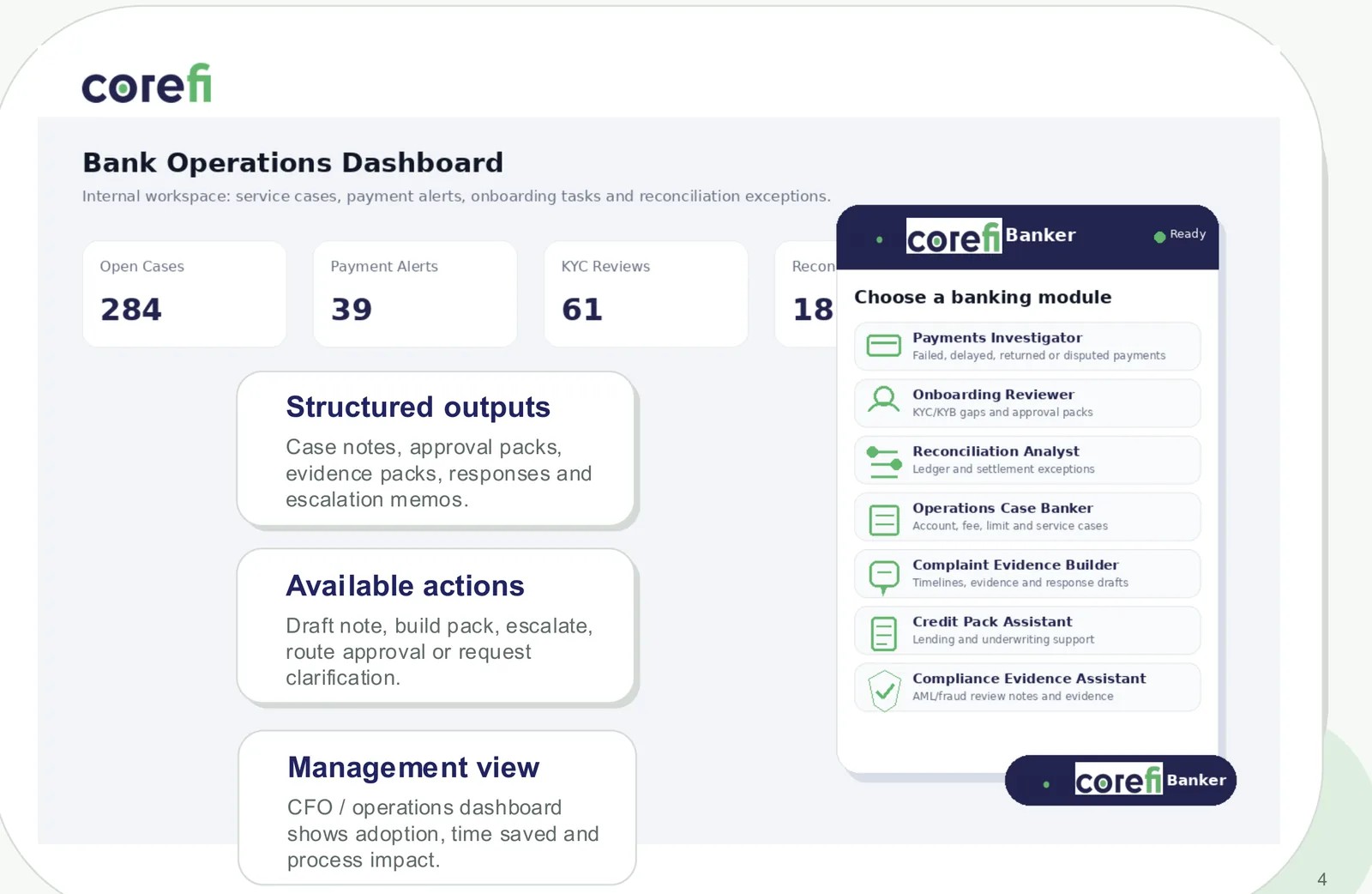
CoreFi is built with controls for agent operations so an AI workflow inherits the same scopes, limits, approvals and audit a human operator would face. The control plane is the platform, not a checklist on a slide.
Role-based access and scoped API tokens per agent, per workflow and per environment. An agent that can read balances cannot post a journal entry unless its role grants it.
Transaction and exposure limits, customer-segment rules, jurisdictional restrictions and model-output filters, evaluated on every step before any side effect on the ledger. Failed checks stop the workflow.
Workflows declare which steps require a human. CoreFi routes the case to the right reviewer dashboard with full evidence; the decision (approve, reject, edit) is logged and resumes the workflow.
One append-only case-level record per workflow: trigger, retrieved data, model and prompt version, plan, policy outcome, API calls, side effects, escalations, human decisions, final state; exportable for internal, external and supervisory review.
Run governed workflows on ChatGPT, Claude, Gemini, your own hosted models, or a mix. The control plane, audit log and policy gates do not change when you swap the underlying model.
Real-time dashboards on agent volumes, override rates, escalation queues, policy hits and model drift signals, with alerting hooks for risk and model owners.
CoreFi runs on the same platform across deployment models. The difference is who runs the infrastructure, where customer data lives and how much of the control plane the institution owns end-to-end.
CoreFi-operated multi-tenant cloud. Fastest go-live, shared upgrades, regional residency on request. Designed for fintechs, neobanks and digital lenders that want infrastructure without operations overhead.
Single-tenant deployment in a CoreFi-managed cloud region. Dedicated database, dedicated network, dedicated upgrade window. Designed to support institutions with stricter isolation requirements.
CoreFi deployed into the institution’s own cloud account (AWS, Azure, GCP) or a sovereign-cloud region. The institution controls the perimeter; CoreFi operates the platform on it. Available on request.
Customer data and audit records pinned to a chosen jurisdiction: EU, LATAM regions and others on request. Backups and processing follow the same residency boundary.
Every figure below reflects production CoreFi deployments. We publish what we can prove and replace estimates with evidence as customers go live.
We will walk you through the seven-step lifecycle on a live workflow, show the case-level audit record and scope a first deployment together: onboarding, credit or operations.