![AI in Financial Infrastructure: Moving Beyond Buzzwords to Production Systems [2026]](/wp-content/uploads/2024/11/3.png)
Every fintech vendor's 2026 roadmap mentions "AI-powered" something. Very few can tell you what that actually means in production.
This article goes deep on four AI applications that are delivering real value in financial infrastructure today — not theoretical use cases, but systems running in production with measurable ROI. We'll cover the architecture, the data requirements, the regulatory constraints, and the honest limitations.
Application 1: Real-Time Fraud Detection
The Problem
Traditional rule-based fraud detection generates 95%+ false positives. Every false positive is a blocked legitimate customer, a support call, and eroding trust. Meanwhile, actual fraud gets more sophisticated — synthetic identities, account takeover via SIM swaps, and authorized push payment (APP) fraud now account for the majority of financial losses.
The AI Solution
Modern fraud detection uses a layered ML approach:
Layer 1 — Behavioral Biometrics (Device & Session)
- Keystroke dynamics, mouse movement patterns, touch pressure
- Device fingerprinting and anomaly detection
- Session behavior modeling (time of day, navigation patterns, typical actions)
Layer 2 — Transaction Risk Scoring (Real-Time)
- Ensemble model combining gradient-boosted trees (XGBoost/LightGBM) for tabular features with neural networks for sequence patterns
- Features: amount, merchant category, location, velocity, device, time, counterparty history
- Sub-100ms inference latency required for payment authorization
Layer 3 — Network Analysis (Near Real-Time)
- Graph neural networks mapping relationships between accounts, devices, IPs, and merchants
- Identifies fraud rings and money mule networks
- Batch-updated every 5-15 minutes, used as features in Layer 2 scoring
Architecture Pattern
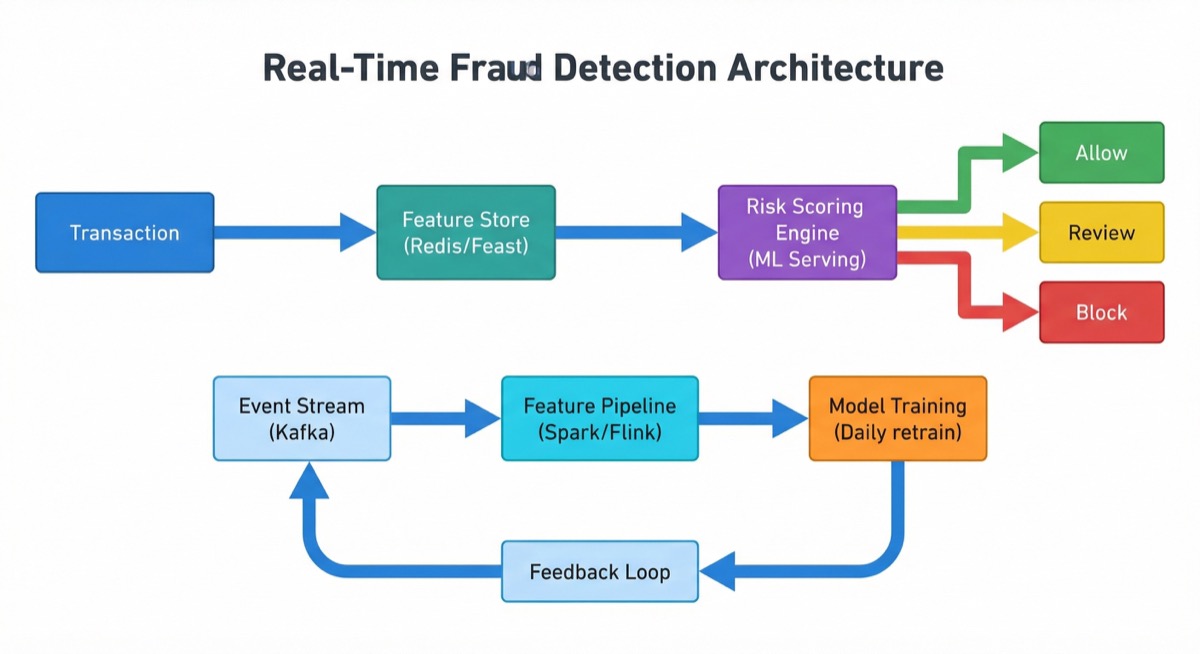
Data Requirements
- Minimum 6 months of labeled transaction data (fraud/not-fraud)
- Class imbalance is extreme: typically 0.1-0.3% fraud rate
- SMOTE and other oversampling techniques help but don't eliminate the cold start problem
- New entrants should start with rule-based systems augmented by vendor models, then train custom models once sufficient data accumulates
Measured ROI
| Metric | Before AI | After AI | Improvement |
|---|---|---|---|
| False positive rate | 95-98% | 40-60% | 50-60% reduction |
| Fraud detection rate | 60-70% | 85-95% | 25-35% improvement |
| Manual review volume | 100% of alerts | 20-30% of alerts | 70-80% reduction |
| Average detection time | Minutes-hours | <500ms | Real-time |
| Annual fraud losses | Baseline | -40-60% | Significant reduction |
For a mid-size fintech processing €500M/year, reducing fraud losses by 40% typically saves €500K-2M/year while simultaneously reducing the fraud ops team by 2-3 FTEs (€150-250K/year savings).
Regulatory Constraints
- Explainability: EU AI Act classifies credit scoring and fraud detection as "high-risk." Models must provide explanations for decisions that impact customers.
- Right to human review: Customers who are blocked or flagged must be able to request human review (GDPR Art. 22)
- Non-discrimination: Models must be tested for bias across protected characteristics
- Data retention: Transaction data used for model training falls under GDPR retention limits
Application 2: AML/Compliance Automation
The Problem
Financial institutions spend €50-200K/year per compliance FTE, and a mid-size firm typically needs 5-15 compliance staff. The vast majority of their time is spent on repetitive tasks: screening alerts, reviewing transactions, writing SARs, and checking sanctions lists.
The AI Solution
Intelligent Alert Triage:
- NLP models that read alert context and recommend dismiss/escalate/investigate
- Reduces Level 1 analyst workload by 60-80%
- Learning from analyst decisions to improve over time
Automated SAR Narrative Generation:
- Large Language Models (LLMs) that draft Suspicious Activity Reports from structured data
- Analyst reviews and edits (never fully automated — regulatory requirement)
- Reduces SAR writing time from 2-4 hours to 30-60 minutes
Dynamic Risk Scoring:
- Customer risk profiles that update in real-time based on transaction patterns
- Replaces static annual reviews with continuous monitoring
- Flags behavioral changes (sudden international transfers, new counterparties, unusual volumes)
Enhanced Due Diligence (EDD) Automation:
- Automated gathering of public information (company registries, UBO databases, adverse media)
- NLP-powered adverse media screening with relevance scoring
- Structured EDD reports generated automatically, reviewed by compliance officers
Measured ROI
| Metric | Impact | Annual Savings |
|---|---|---|
| Alert triage automation | 70% of L1 alerts auto-resolved | €150-300K (2-4 FTEs) |
| SAR writing assistance | 60% time reduction | €80-150K |
| Dynamic risk scoring | 50% fewer false positive EDD triggers | €50-100K |
| Adverse media screening | 80% reduction in manual searches | €40-80K |
| Total | €320-630K/year |
The Honest Limitations
- You can't fully automate compliance decisions. Regulators require human accountability. AI assists; humans decide.
- Model drift is real. Criminal typologies change. Models trained on last year's patterns miss this year's schemes. Monthly retraining is the minimum.
- Regulatory approval varies. Some NCAs embrace AI in compliance; others are skeptical. Check with your regulator before deploying.
Application 3: AI-Powered Credit Decisioning
The Problem
Traditional credit scoring relies on credit bureau data and manual underwriting rules. This excludes millions of creditworthy individuals (thin-file, immigrants, gig workers) and is too slow for modern lending products that promise instant decisions.
The AI Solution
Alternative Data Credit Scoring:
- Bank transaction history analysis (cash flow patterns, income stability, spending behavior)
- Open banking data (with customer consent) for real-time financial health assessment
- Behavioral data from application process (time spent, corrections, device)
Instant Decision Engine:
- Pre-trained models that score applications in <2 seconds
- Confidence-based routing: high confidence → auto-approve/deny, low confidence → human review
- Continuous learning from loan performance data
Dynamic Pricing:
- Risk-adjusted interest rates calculated per application
- Real-time market condition integration
- Portfolio-level optimization (balancing risk appetite with growth targets)
Architecture Pattern
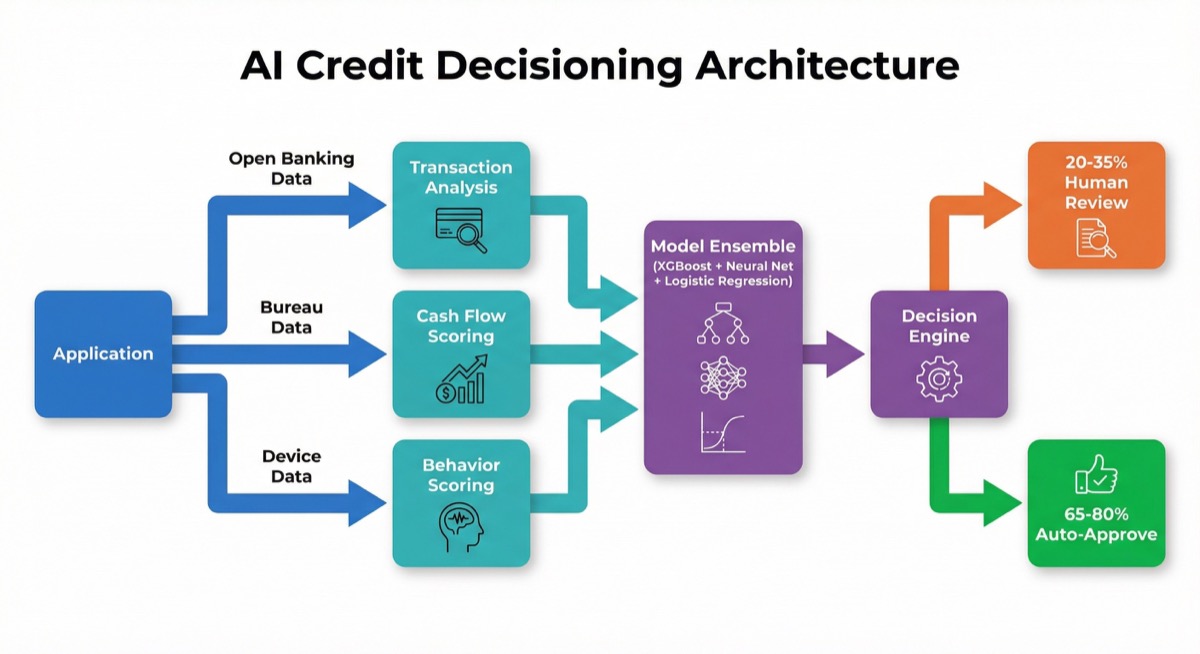
Measured Impact
| Metric | Traditional | AI-Powered | Change |
|---|---|---|---|
| Decision time | 1-5 days | <2 seconds | 99.9% faster |
| Auto-decision rate | 20-40% | 65-80% | 2-3x improvement |
| Default rate | Baseline | -15-25% | Better risk selection |
| Approval rate | Baseline | +10-20% | More creditworthy borrowers captured |
| Cost per decision | €15-30 | €2-5 | 80% reduction |
Application 4: Agentic AI for Operations
What's New in 2026
Agentic AI — autonomous AI systems that can plan, execute, and adapt multi-step workflows — is the frontier application in financial infrastructure. Unlike traditional ML models that score or classify, agentic systems take actions.
Production Use Cases (Today)
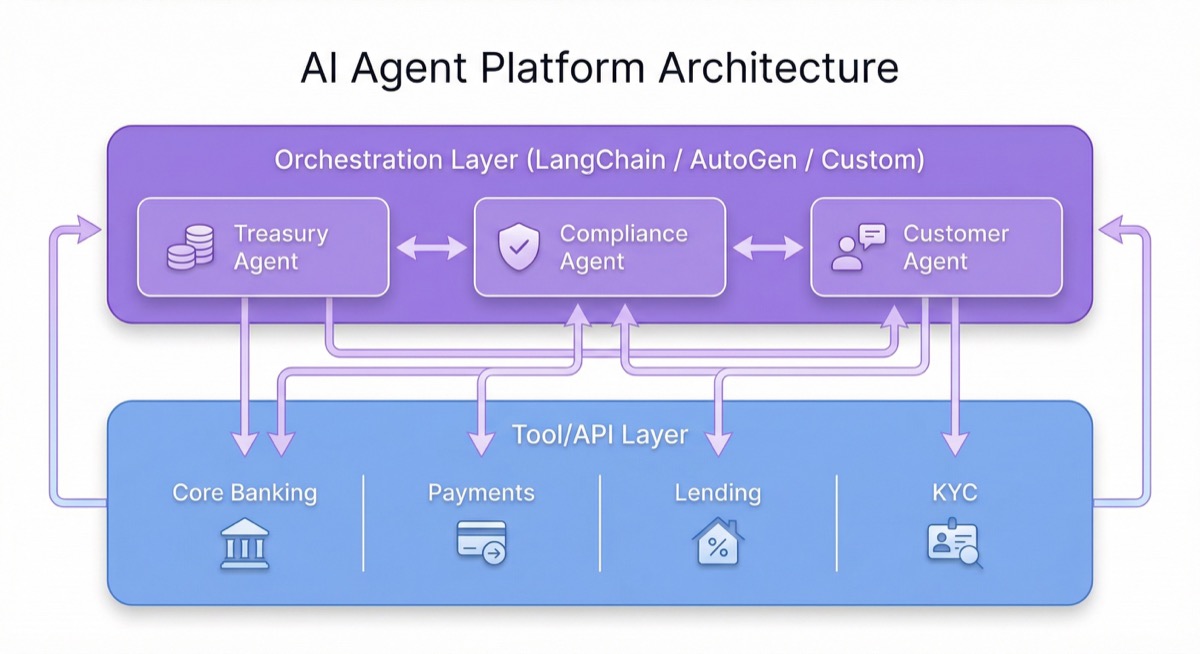
1. Intelligent Treasury Management
- AI agent monitors liquidity positions across accounts, currencies, and counterparties
- Automatically executes sweeps, placements, and FX hedges within pre-set parameters
- Escalates to human treasury manager for decisions exceeding risk limits
2. Automated Regulatory Reporting
- Agent collects data from multiple systems (core banking, payments, lending)
- Generates regulatory reports in required formats
- Validates completeness, flags anomalies, and submits on schedule
- Handles regulator queries by pulling supporting documentation
3. Customer Service Orchestration
- AI agent handles account inquiries, transaction disputes, and product questions
- Accesses core banking APIs to retrieve real data (not hallucinated responses)
- Escalates complex cases to human agents with full context summary
- Processes routine requests end-to-end (address changes, card replacements, statement generation)
4. Reconciliation and Exception Handling
- Agent monitors settlement and reconciliation queues
- Automatically investigates and resolves standard exceptions (timing differences, format mismatches)
- Creates investigation tickets for genuine discrepancies with preliminary root cause analysis
Architecture: The AI Agent Platform
The Critical Guardrails
Agentic AI in financial services requires strict boundaries:
- Action limits: Maximum transaction amounts an agent can execute without human approval
- Audit trails: Every action logged with reasoning chain
- Kill switches: Immediate human override at any point
- Regulatory compliance: Agent actions must comply with all applicable regulations
- Testing: Extensive simulation before production deployment
ROI Projection
For a financial institution with 200K accounts:
- Treasury management automation: €80-150K/year (1-2 FTE equivalent)
- Regulatory reporting automation: €60-120K/year (reduced errors + staff time)
- Customer service automation (60% deflection): €150-300K/year (3-5 FTE equivalent)
- Reconciliation automation: €40-80K/year (1 FTE + faster resolution)
- Total: €330-650K/year
Implementation Roadmap
Phase 1: Foundation (Months 1-6)
- Implement real-time fraud scoring (highest immediate ROI)
- Deploy compliance alert triage
- Build feature store and ML infrastructure
- Investment: €200-400K | Expected ROI: €300-500K/year
Phase 2: Expansion (Months 6-12)
- Launch AI credit decisioning
- Implement SAR generation assistance
- Dynamic customer risk scoring
- Investment: €150-300K | Expected ROI: €400-700K/year
Phase 3: Agentic (Months 12-24)
- Deploy treasury management agent
- Launch customer service AI
- Automated regulatory reporting
- Investment: €200-400K | Expected ROI: €300-600K/year
Cumulative 2-year investment: €550K-1.1M Cumulative annual ROI by year 2: €1.0-1.8M/year
The Platform Requirement
AI in financial infrastructure isn't a standalone product — it's a capability layer that sits on top of core banking. The platform must provide:
- Real-time event streams (every transaction, every state change)
- Rich APIs for AI agents to query and act
- Structured audit trails for regulatory compliance
- Feature store integration for ML model serving
- Granular permissions for AI agent actions
CoreFi's API-first architecture provides all of these as native capabilities, making AI integration a configuration exercise rather than a development project.
Ready to move beyond AI buzzwords? CoreFi's modular platform provides the API-first foundation for production AI in financial services — from fraud detection to agentic operations. Schedule a technical deep-dive with our team.