
The Question Every Partner Asks First
When a new partner approaches CoreFi, the conversation always starts the same way: "How long before we can see it working?"
The answer: one week.
Not a slideshow. Not a sandbox with dummy data. A fully functional proof of concept running on production-grade infrastructure, with real API endpoints, real compliance flows, and a real path to going live.
In an industry where launching a new financial product traditionally takes 6–12 months of licensing, integration, and vendor negotiations, seven days reframes the entire conversation. It's no longer "build or buy." It's "let's just try it."
Why Seven Days Is Possible
The speed doesn't come from cutting corners. It comes from architecture decisions made years ago.
CoreFi operates as a regulated infrastructure provider across multiple EU markets. That means the heavy lifting — the compliance layer, KYC/AML workflows, payment rails, banking integrations — is already in place and battle-tested with real transaction volume.
New partners don't rebuild any of this. They plug into what's already live.
The Multi-Tenant Engine
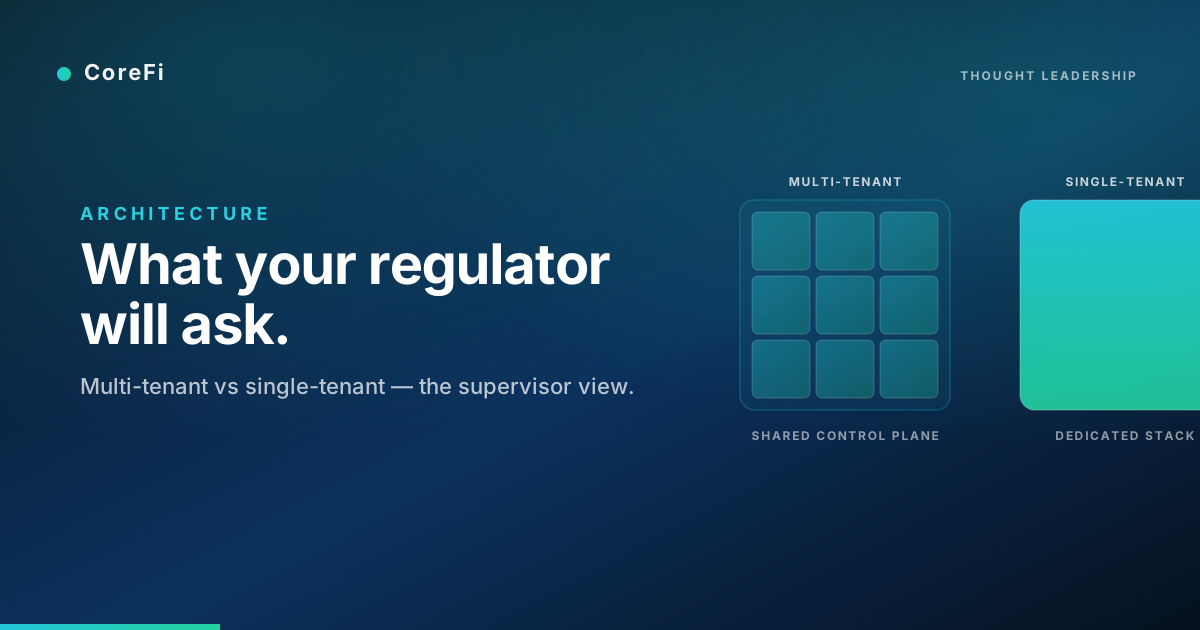
At CoreFi's core is a multi-tenant engine that powers every use case through the same foundational platform:
- Digital lending — origination, servicing, collections, investor matching
- Core banking services — accounts, ledger, payments, card issuance
- Asset tokenization — fractional ownership, compliance-wrapped tokens, secondary market
- Payment orchestration — multi-processor routing, reconciliation, settlement
Each client gets their own configuration layer — products, compliance rules, fee structures, branding, user journeys — without touching the underlying engine. Think of it as deploying a new tenant, not building a new platform.
What "Configuration, Not Code" Actually Means
When we say a partner can launch in seven days, here's what's happening behind the scenes:
Day 1–2: Scoping & Tenant Setup The partner defines their use case: What financial products? Which markets? What investor or borrower profiles? CoreFi provisions a new tenant environment with the appropriate modules activated.
Day 3–4: Product Configuration Fee structures, interest calculations, repayment schedules, risk parameters — all configured through CoreFi's admin layer. No custom development. The same engine that runs €200M+ in annual volume adapts to the partner's specific needs through configuration.
Day 5–6: Integration & Branding API keys issued. The partner connects their frontend (or uses CoreFi's white-label UI). KYC/AML flows are activated with the appropriate provider for their jurisdiction. Payment rails are connected — whether that's SEPA, card processing, or stablecoin settlement.
Day 7: Live PoC The proof of concept goes live. Real users can onboard, real transactions can flow, and the partner has a working system they can demo to their stakeholders, board, or investors.
The Compliance Advantage
Here's what most people underestimate: the compliance layer is the bottleneck, not the technology.
Getting a new financial product to market isn't primarily a software challenge. It's a regulatory one. You need licensing (or access to someone else's), AML procedures, transaction monitoring, regulatory reporting, and audit trails — all before a single euro moves.
CoreFi already has this. Operating under existing regulatory frameworks across Italy, Spain, and expanding across the EU, CoreFi's compliance infrastructure is:
- Pre-built — KYC/AML workflows with configurable risk scoring
- Multi-jurisdictional — adapts to local requirements per market
- Auditable — complete transaction trails and regulatory reporting
- Tested — processing real volume across multiple live tenants
When a partner launches a PoC on CoreFi, they're inheriting years of compliance work. That's the real accelerator — not just the APIs.
What Comes After the PoC
Seven days gets you a working proof of concept. But the real value is what happens next.
Because the PoC runs on the same infrastructure as CoreFi's production environment, the path from PoC to production is a configuration change, not a migration. There's no throwaway prototype. No rebuilding on "the real platform." The system the partner tested is the system they'll scale on.
Typical Post-PoC Timeline
- Week 2–4: Refinement — adjust product parameters based on PoC feedback, finalize branding, complete legal agreements
- Month 2: Soft launch — limited rollout with real users, monitoring performance and compliance
- Month 3: Full production — scale up volume, activate additional features, expand to additional markets if needed
Compare this to the traditional path: 3–6 months just to select a vendor, another 6–12 months for implementation, and ongoing maintenance costs that can dwarf the initial build. CoreFi compresses the entire journey from years to weeks.
Who This Is For
The seven-day PoC isn't just for startups. It's designed for:
- Banks and financial institutions exploring embedded lending or tokenization without committing to a multi-year platform build
- Fintech companies that need core infrastructure but want to focus their engineering on differentiation, not plumbing
- Corporate treasuries looking at alternative funding channels like crowdlending or invoice financing
- Confidi and guarantee funds modernizing their operations with digital lending infrastructure
- Regulated entities entering new markets and needing compliant infrastructure that's already licensed
The common thread: organizations that don't want to spend 12 months and seven figures just to find out if an idea works.
The Economics of Speed
There's a financial argument for the seven-day approach that goes beyond time savings.
Traditional fintech platform builds carry enormous upfront risk. You're committing budget, engineering resources, and organizational bandwidth before you have any market validation. If the product doesn't work, you've burned months and millions.
A seven-day PoC inverts this. The cost of experimentation drops to near zero. Partners can:
- Test multiple product configurations before committing to one
- Validate market demand with real users before scaling investment
- Present working demos to investors or boards instead of pitch decks
- Fail fast and cheaply if a hypothesis doesn't hold
In venture-backed fintech, this speed is a competitive weapon. In regulated financial services, where conservatism usually means slowness, it's transformative.
Try It
If you're building a financial product and wondering whether to build or buy the infrastructure, the honest answer is: neither — just try it.
Seven days. One working proof of concept. Real infrastructure, real compliance, real APIs. Then decide.
Book a meeting to discuss your use case, or explore our products to see what's possible.