This guide is written for CEOs, board members and strategy leaders who have to decide whether, and how, to put AI agents inside core banking operations. It sets out what agentic AI core banking is in plain language, the three questions every board asks before approving a programme, and the questions worth asking any vendor. The decision frames are vendor-neutral; CoreFi appears as the worked example. If you are the internal champion, this is the page to forward before the next strategy session. For the executive-facing version of this argument, see the CEO page.
Risk, reversibility and cost: the three frames that decide the vote, the control envelope around every agent, and the evidence a board should expect from any vendor. Watch it before the strategy session; the full guide follows below.
The definition, in board language
What agentic AI core banking is.
Strip away the terminology and the idea is simple: AI agents run banking workflows, and the platform, not the model, enforces the rules. An agent prepares a credit decision, triages a KYC case or investigates a compliance alert the way a trained operator would. What makes this acceptable in a regulated institution is not the intelligence of the model; it is the control envelope around it. On a platform such as CoreFi, five agent roles, Credit, Onboarding, Service, Compliance and Operations, work inside the core under scoped permissions, transaction limits and mandatory human approvals.
01
Agents are operators, not oracles
Each agent acts through the same APIs a human operator would call, with a defined role, scope and limit per workflow. An agent that can read balances cannot post a transaction unless its role grants it.
02
Policy is enforced by the platform
Risk thresholds, jurisdiction rules and approval routings live in a runtime the agent must pass through before any effect on the ledger. The model proposes; the platform enforces; the human approves what policy says they must.
03
Every step follows one lifecycle
Every workflow runs the same seven steps: Sense, Plan, Check, Act, Audit, Escalate, Learn. A board does not need to evaluate each use case separately; it needs to evaluate the lifecycle once and then ask where it applies.
One boundary matters at board level: the platform provider supplies infrastructure, and the institution remains the regulated entity holding its own licenses. Adopting any platform, CoreFi included, does not make an institution compliant; it changes what the institution can evidence to the people who decide whether it is.
The three board questions
Risk, reversibility, cost: the frames that decide the vote.
In our experience, board discussions of agentic AI converge on three questions. Each has a decision frame that works regardless of vendor, and each has a concrete answer in the CoreFi case. The frames are the part to keep even if the vendor changes.
Question 1: What is the risk and control story?
The frame. Do not ask the board to assess model internals; no board can. Ask it to assess the control envelope, the same way it assesses a new human operator: who scopes what the agent can touch, what stops it before money moves, who reviews the cases that matter, and what record remains afterwards. If the vendor's answer to any of those four is "the model is very good", the control story does not exist.
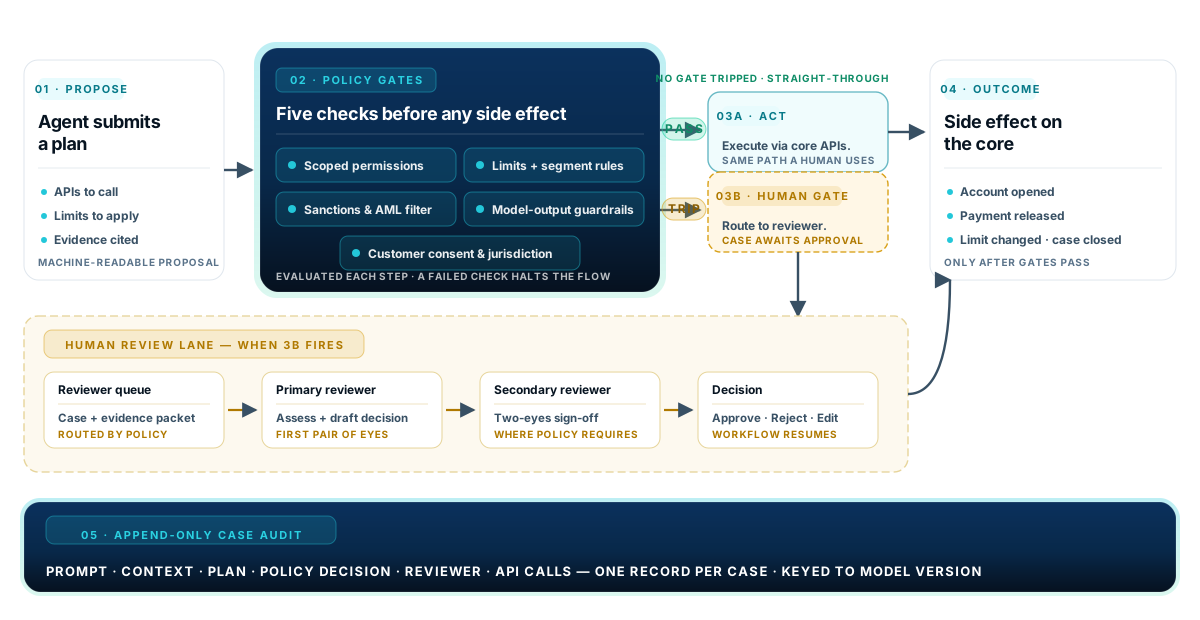
The CoreFi answer. Every agent action passes the Check step before any side effect: scoped permissions, transaction and exposure limits, sanctions and AML filters, model-output guardrails and consent checks. Steps that policy marks for a human route to a reviewer queue with the evidence attached. Both paths write into one append-only case-level audit record. The control documentation lives in the Trust Center.
The control envelope a board is actually approving: policy gates before execution, human review where policy requires it, one audit record either way.
Question 2: Is the programme reversible?
The frame. Fund phases, not programmes. A board should be asked to approve one bounded phase at a time, each with a defined scope, a success metric agreed in advance, and an explicit exit posture: what happens to customers, accounts, ledger data and audit history if the institution stops here. A modernization plan that only works if every phase succeeds is not a plan; it is a bet.
The CoreFi answer. The adoption paths are built to that shape: a first journey live in 8–14 weeks, a discrete segment running alongside the legacy core in 16–24 weeks, and, where the board mandates full retirement of the legacy core, a phased migration over 18–36 months with cohort-by-cohort cutovers. Each phase has a documented exit posture, and customer, account, ledger and audit data are exportable through documented APIs in standard formats. The board never has to approve the whole journey to approve the next step.
Question 3: What does the cost trajectory look like?
The frame. Ask about the shape of the cost curve, not a point ROI. Most institutions carry three lines that grow independently: the run cost of the legacy core, the cost of AI tools bolted alongside it, and the operations headcount underneath both. The board question is which of those lines a programme bends, by when, and how that claim will be evidenced. Treat any vendor ROI figure that cannot be traced to a published, comparable outcome as marketing.
The CoreFi answer. CoreFi consolidates the core, the AI workflow control plane, the audit trail and the operations console into one platform and one cost line, so workflow volume can grow without proportional growth in operations headcount. We do not publish projected savings as outcomes: where customers authorize disclosure, verified results are published as anonymized metric ranges on Client Outcomes, on the same axes every time, so a board can compare deployments rather than testimonials.
Vendor diligence
What to ask any vendor, including us.
These questions are deliberately vendor-neutral. A credible agentic core banking vendor should answer all of them with artefacts, not assurances. Where CoreFi's answer is published, the table says where.
Question for the vendor
What a good answer looks like
Where CoreFi answers it
Show us one case record, end to end.
A single record tying the trigger, retrieved data, model and prompt version, plan, policy decisions, human approvals and ledger effects for one real case. Not an architecture slide.
Live in a demo; the audit model is described on the Trust Center.
What can the agent never do without a human?
Named action types and thresholds enforced by the platform runtime, not by instructions in a prompt that the model could ignore.
The workflow stops before any side effect on the ledger, the failure is logged, and a defined owner sees it. "The agent retries" is the wrong answer.
The Check step of the seven-step lifecycle, demonstrated in the governance demo.
How do we exit, at each phase?
A documented exit posture per phase and data export in standard formats through documented APIs. Exit terms offered only at contract end are a lock-in signal.
Adoption paths and exit postures on For CEOs and the implementation pages.
Where is this in production today?
Verifiable deployment counts, account volumes and named geographies, maintained on a public page, not a logo wall.
Nothing in the controls. Permissions, policy gates and audit should be independent of which model runs underneath, or the institution inherits model lock-in on top of vendor lock-in.
For the practitioner-level version of these questions, written for the CIOs and COOs who will run the diligence, see the operator's playbook: Agentic AI in Banking.
The board evidence pack
What a board should expect to see, not be told.
A programme the board can approve produces artefacts at every phase. Whatever platform an institution chooses, the evidence pack should contain at least three things. On CoreFi these artefacts are by-products of how the platform runs, and the pack is available on request.
Audit records
One immutable record per workflow, exportable for internal review and supervisory request. If the audit record has to be assembled by hand after the fact, it is not an audit record. See the Trust Center.
A reversibility plan
The exit posture per phase, in writing, before the phase is funded: what is exported, in which formats, and what keeps running. CoreFi documents this per adoption path, with no proprietary data lock-in.
Published outcomes
Results on consistent, comparable axes. CoreFi publishes verified production figures on In Production and anonymized outcome ranges on Client Outcomes as customers authorize disclosure.
200k+End-customer accounts running on CoreFi rails.20+Production deployments across banks, lenders and fintechs.6Live geographies: Italy, Spain, France, Argentina, Chile, Bolivia.99.9%Platform uptime measured against operational SLOs.
Take the frames to your board. Bring the questions to us.
A CEO briefing walks through the three board questions against your institution's products, markets and constraints: the control story on a live workflow, the phase plan with its exit postures, and how the cost discussion shapes up. Thirty minutes, board-grade output, before you commit to anything.