
Onboarding Journeys with Agentic AI — KYC Without Losing Customers | CoreFi
CoreFi · 10 min read
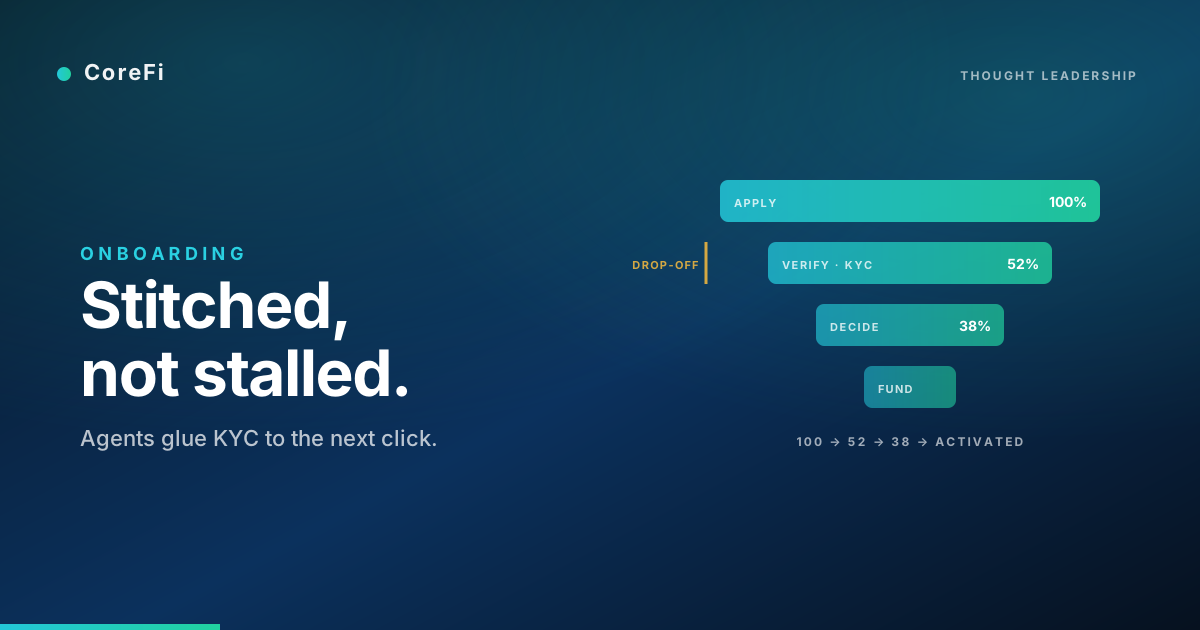
The most expensive moment in retail banking is the one where the customer abandons the application. Every digital bank has the same dashboard: a funnel that starts wide, narrows aggressively at ID verification, and ends with 40 to 70 percent of applicants gone before they ever held an account.
The CDO's question is whether agentic AI can move that number — without breaking the AML, KYC and sanctions controls that exist for very good reasons.
The honest answer, from production deployments we've seen and run, is: yes, but only if you think about the onboarding journey, not the onboarding form.
Why onboarding funnels collapse
The drop-off points are unsurprising once you watch enough sessions:
- The document-upload step. The customer's phone camera doesn't focus. The image is rejected silently. They retry once, twice, then close the app.
- The PEP/sanctions false positive. The customer shares a name with a sanctioned individual. The application is suspended pending manual review. They never come back, because they were never told what happened.
- The "additional documents" loop. The customer is asked for a utility bill. They upload one. It's the wrong kind of utility bill. They are asked for another. They give up.
- The waiting period. The application reaches "under review." Nothing changes for 48 hours. The customer assumes it's broken.
- The cross-channel break. They started on mobile, were sent to a desktop form, then back to mobile for a video selfie. Each handoff loses a tranche of applicants.
None of these are KYC failures. They are journey failures wrapped around KYC steps. The KYC itself is doing what it should — flagging risk, requiring evidence, escalating to a human when needed. The journey is what loses customers.
What agents change about the journey
Agentic AI doesn't replace the KYC stack. It coordinates the customer's path through it.
A Customer Agent absorbs the friction. Instead of a static error message saying "document rejected," the Customer Agent explains what was wrong, why it matters, and how to fix it — in the customer's language, on the channel they're already using, at the moment the failure happens. A blurry passport photo becomes a 30-second guided retry, not a dead end.
An Operations Agent runs the back-of-house in parallel. While the customer is uploading documents, the Operations Agent is already pre-classifying them, routing them to the appropriate verification engine, and queuing the next step. The customer is no longer waiting for a batch process — they are waiting for an event.
A Compliance Agent handles the genuinely-ambiguous cases. When a sanctions screening throws a possible match, the Compliance Agent enriches the case with all the public-record data needed to disposition it — and either clears it within seconds, or escalates with a complete case file to a human reviewer. The customer doesn't see "under review." They see "we'll be back to you within the hour."
A Risk Agent makes the credit decision the customer is waiting for. If onboarding includes a credit limit or a product eligibility check, the Risk Agent runs it once the KYC artefacts are in — not as a separate step the customer initiates.
The architecture matters: this is not one chatbot doing five jobs. It is four specialized agents, coordinated by an orchestration layer, doing their own job within their authority. We explain why in The Five-Agent Model.
What this looks like to the customer
Concretely, a well-designed agentic onboarding journey in 2026 looks like:
- One channel, end to end. The customer starts on the channel they prefer and stays there. If a video selfie is needed, it happens inside the same chat / app session — not via a SMS link to a third-party microsite.
- Conversational repair. When something goes wrong — wrong document, blurry image, name mismatch — the customer is not bounced back to "the form." They are asked, in language, what they meant.
- Status that updates in real time. "Under review" becomes "your ID is verified, we're checking sanctions, this typically takes 30 seconds." Each transition is explicit.
- A graceful pause. If the customer leaves mid-application, they don't restart from zero. The Customer Agent picks up the conversation 24 hours later with state intact.
- A clear final outcome. Approved, declined, or routed to a human with a named contact and SLA — never a silent abandon.
The customer experience is closer to a private banker walking them through onboarding than a web form. Done well, it works at retail scale.
The KYC stack stays where it is
This is the part that often surprises CDOs the first time they see it implemented properly: the underlying KYC and AML stack — ID verification vendor, sanctions list provider, PEP screening, transaction monitoring — barely changes. The agents are above that stack, not replacing it.
Why this matters:
- Vendor relationships are preserved. You don't need to rip out the document-verification vendor you spent two years procuring.
- Compliance artefacts stay intact. Sanctions screening results, KYC evidence packs and audit trails are produced by the same engines that produced them before — they're just routed through a more humane interface.
- Regulator-facing controls don't change shape. Your AML transaction monitoring still runs, still alerts, still escalates. The agents change the customer journey, not the supervisory perimeter.
This is the difference between "AI onboarding" as a marketing label and AI onboarding as an architecture: the second leaves the AML/KYC machinery alone and reorganizes the customer journey around it.
What the numbers actually move
From the programs we work with, four metrics move in measurable ways when agentic AI is layered into onboarding:
- Completion rate. Applicants who finish the journey, not just start it. Improvements of 15 to 30 percentage points are common when the document-upload, sanctions-clarification and waiting-period steps are reworked.
- Time-to-first-account. The wall-clock from application start to a usable account. Moves from days (typical for "human-in-the-loop on everything") to minutes for low-risk cohorts, hours for medium-risk, days for genuinely high-risk cases.
- Cost-to-onboard. With routine cases handled end-to-end without human intervention, the cost-per-completed-application drops materially. Most of the win is on the medium-risk middle, not the easy or the hard ends.
- False-positive resolution time. Sanctions-screening false positives that used to wait in a queue are now triaged in seconds when the public-record evidence is clear-cut. The genuinely ambiguous cases still go to a human — but they go with a case file, not a name and a vendor alert.
What doesn't (and shouldn't) move:
- The sanctions hit rate. If your agentic journey lets more sanctions risk through, you've broken the architecture. The agent reduces friction in dispositioning, not in the underlying screening.
- The supervisory artefact set. Your KYC packs, AML reports and audit trails should look the same to a supervisor — possibly richer, never thinner.
The two failure modes to avoid
Two patterns kill agentic onboarding programs.
The "smart chatbot in front of the same broken form." A polished conversational layer over a flow that still bounces the customer between three vendor microsites. The chatbot smooths over the symptoms; the journey is still broken.
The agent that quietly takes compliance decisions. An agent that, in the name of "smooth experience," resolves sanctions or PEP ambiguity on its own. This is the highest-cost failure mode in the design: it looks great in the demo, and it eventually surfaces during an inspection as decisions made by an AI system with no traceable human accountability.
Done well, the agent removes friction from the journey and removes ambiguity from the case file the human reviewer eventually sees — it does not make the compliance decision itself.
Where CoreFi fits
CoreFi's Customer Agent, Operations Agent and Compliance Agent are designed to orchestrate around your existing KYC/AML stack — not replace it. The platform is designed to include onboarding journey templates, the audit pipeline supervisors expect, and the integration patterns to plug your existing ID, sanctions and bureau vendors into an agentic journey without re-platforming them.
The point isn't to onboard customers without compliance. It is to onboard them without losing them to compliance theatre.
See the underlying product page: CoreFi Customer Onboarding.
![Cloud-Native, Agentic, Compliant-by-Design — In That Order [2026 CEO View] | CoreFi](/assets/images/articles/cloud-native-agentic-compliant-by-design-hero.svg)
![Multi-Tenant vs Single-Tenant Core Banking — Regulator Questions [2026] | CoreFi](/assets/images/articles/multi-tenant-vs-single-tenant-what-regulators-ask-hero.svg)
![Lending Lifecycle Automation — Where Humans Still Belong [2026] | CoreFi](/assets/images/articles/lending-lifecycle-automation-where-humans-still-belong-hero.svg)