
Progressive Modernization vs Core Replacement — A 2026 CIO Guide | CoreFi
CoreFi · 9 min read
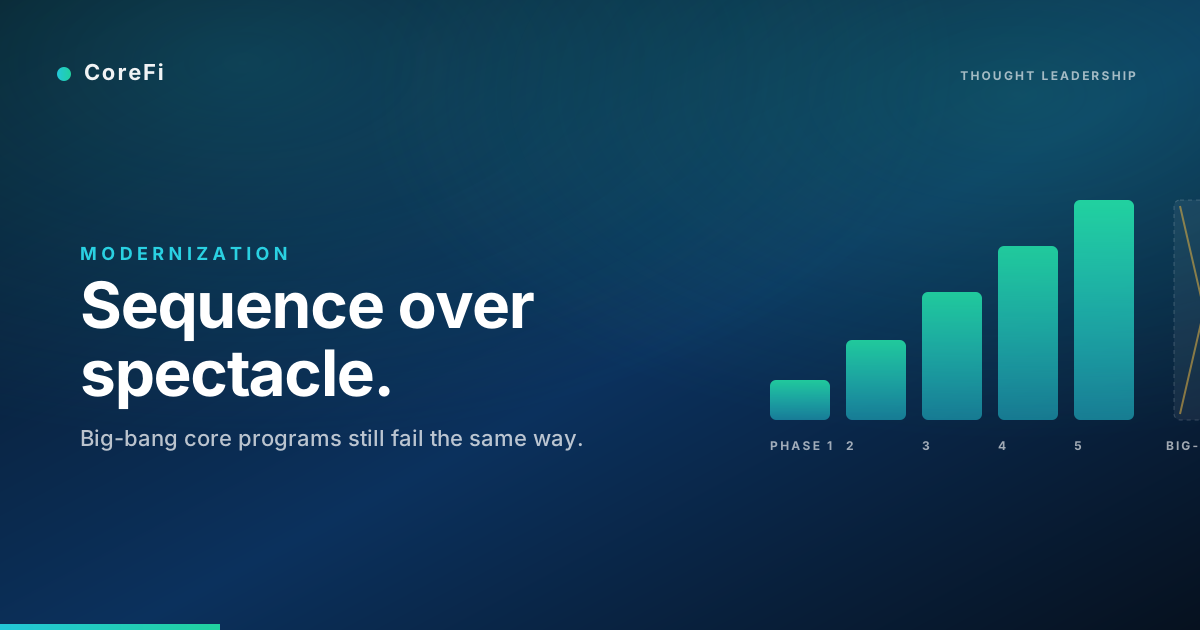
Every two years, a tier-one bank announces a new core banking transformation. Every five years, one of those programs is quietly written down — sometimes for the second time on the same balance sheet. In 2026 the numbers are bigger, the consultants are smarter, and the failure mode is identical.
This article is for CIOs and Heads of Transformation who don't want their name on the next press release.
The big-bang reflex won't die
The pitch is always the same: a new core, a clean ledger, a five-year program, a single cutover weekend that the board can put in the annual report. The problem isn't the destination — modern, cloud-native banking infrastructure is genuinely better. The problem is the path.
Three things have changed since the last cycle of core programs:
- Banks now run hundreds of integrations, not dozens. Cutover risk scales with the integration surface, not with the ledger.
- Customer expectations have flattened. A 30-minute outage that was acceptable in 2008 is a viral incident in 2026.
- Regulators want continuous evidence, not annual attestation. DORA's operational resilience expectations are not friendly to a "blackout weekend" cutover plan.
A multi-year transformation that arrives in one tranche concentrates all of that risk into one event. Progressive modernization spreads it.
What progressive modernization actually means
Progressive modernization is not a euphemism for "do nothing." It is a deliberate architectural pattern with three properties:
- The legacy core keeps running until its last book is migrated. There is no cutover weekend.
- New capabilities are built on a modern, API-first platform that sits alongside the legacy core, not on top of it.
- Customers, products and books are migrated one cohort at a time — usually by product, segment or geography — over 18 to 36 months.
The pattern is sometimes called strangler-fig, after Martin Fowler's term: the new system grows around the legacy core, takes traffic incrementally, and the legacy core eventually has nothing left to serve. We cover that pattern in depth in Coexisting with the Legacy Core — Strangler-Fig in Practice.
What makes this work in 2026 — and didn't a decade ago — is the combination of two architectural shifts:
- Headless, API-first banking infrastructure that can be composed alongside any legacy core through an integration layer, without needing to own the customer or the ledger from day one.
- Agentic AI orchestration that compensates for data gaps, automates reconciliation between old and new books, and absorbs the operational tax that always comes with running parallel systems.
Without these two, parallel operation was so expensive that CFOs preferred big-bang risk over years of running two cores. With them, the economics finally support an incremental path.
Where progressive modernization beats big-bang — concretely
The CFO conversation is the one that decides this. Here is the comparison most boards never see laid out side-by-side.
| Dimension | Big-bang replacement | Progressive modernization |
|---|---|---|
| Program length | 4–7 years to completion | 18–36 months to first cohort live, 3–5 years to full migration |
| Cutover risk | Concentrated in one event | Distributed across cohorts |
| First customer value | End of program | Within 6–9 months |
| Reversibility | Effectively zero past mid-program | Each cohort can be paused or rolled back independently |
| Regulator perception | "Single point of operational risk" | "Phased de-risking" |
| Talent retention | Burns out program teams | Sustainable cadence |
| Vendor lock-in | High — the new core owns everything | Low — composable layers stay swappable |
The boardroom argument for big-bang is usually framed as efficiency: "let's just rip the band-aid off." In practice, the band-aid has grown into the skin. The efficient move is to graft new tissue onto the old, not to cut.
The four sequencing decisions that matter
If you accept the case for progressive modernization, the next question is what to move first. We see four sequencing decisions that determine whether a program succeeds or stalls.
1. Start where the data is cleanest, not where the pain is loudest.
The instinct is to migrate the most painful product first — usually the one with the worst customer complaints. Don't. Start with the product whose data is most consistent, most recently created and least entangled with legacy edge cases. Build muscle on the easy book, then take the hard one. The institutions that lead with their hardest product almost always stop at the first one.
2. Move new customers before existing customers.
New customers are the easiest cohort in the world: they have no history, no expectations, no legacy account numbers to preserve. Send new originations through the modern stack from day one. Within a year, a meaningful share of the book is already on the new platform and the migration narrative becomes "we're migrating the legacy portion of the book," not "we're replacing everything."
3. Decouple the ledger from the channels.
The mistake that kills modernization programs is treating "the core" as one thing. A modern stack separates the ledger of record from the channels (mobile, web, branch, partner APIs). Migrate the channels onto the new platform first. The legacy ledger keeps running for a while — but customer experience improves in months, not years.
4. Treat agentic AI as a migration tool, not a destination.
Most of the operational tax of running parallel cores is reconciliation: making sure the same balance, the same transaction, the same customer record reads consistently across both books. This is exactly the kind of high-volume, structured, audit-heavy work that an agent control plane is good at. Programs that bring agents in as a migration accelerant — not as a post-migration feature — finish faster and with fewer reconciliation incidents.
The KPIs your board should actually track
A progressive modernization program needs different KPIs than a big-bang one. We recommend tracking:
- % of new originations on the modern stack (target: 100% within 12 months)
- % of book on the modern stack (track quarterly; target depends on book complexity)
- Reconciliation break rate between legacy and modern ledgers (target: under 0.05% of records)
- Mean time to onboard a new product on the modern stack (should drop steadily — this is the long-term ROI)
- Customer-impacting incidents per cohort migration (target: zero customer-visible incidents per cohort)
Notice what's not on the list: "% complete on master migration plan." Progressive modernization is not run as a Gantt chart. It is run as a portfolio of small migrations, each with its own go/no-go decision.
The honest objections
Three objections come up in every CIO conversation we have on this:
"Running two cores is more expensive." Yes, for the duration of the migration. But the comparison is not "two cores" versus "one new core." It is "two cores during migration" versus "one frozen core, a stalled program and another £100m write-down." The right cost benchmark is the all-in risk-adjusted cost, not the run cost of the systems.
"Our vendor doesn't support this." Then your vendor is selling you a destination, not a path. The architecture you want is composable: headless ledger, agentic orchestration on top, channels and origination as separate layers. If your incumbent vendor only sells full-stack replacement, the procurement is the modernization decision — not a separate one.
"The board wants a finish line." Give them one. The finish line is "100% of new originations on the modern stack" — not "the legacy core is shut down." The latter is a side-effect of the former, and it arrives on its own schedule.
Where CoreFi fits
CoreFi is built for this pattern. The platform sits alongside your legacy core through an API-first integration layer, runs new originations on a modern, agentic stack from day one, and migrates the legacy book in cohorts when the data and the operations are ready. Reconciliation, audit trails and operational telemetry are designed to support DORA-aligned oversight from the first cohort.
We don't think every bank should rip out their core. We think every bank should stop pretending the next one will go better than the last one did.
Already evaluating a modernization program? See the migration & coexistence pattern.
![Cloud-Native, Agentic, Compliant-by-Design — In That Order [2026 CEO View] | CoreFi](/assets/images/articles/cloud-native-agentic-compliant-by-design-hero.svg)
![Multi-Tenant vs Single-Tenant Core Banking — Regulator Questions [2026] | CoreFi](/assets/images/articles/multi-tenant-vs-single-tenant-what-regulators-ask-hero.svg)
![Lending Lifecycle Automation — Where Humans Still Belong [2026] | CoreFi](/assets/images/articles/lending-lifecycle-automation-where-humans-still-belong-hero.svg)